
Data Science & Engineering

Data Science & Engineering

By merging advanced computational theory with high-performance infrastructure, this theme offers readers direct access to the forefront of discovery in predictive modeling and systems optimization. You will explore how our experts bridge the gap between raw information and the breakthroughs that drive modern innovation across every global industry.

Sherry Wang from UTA

Bayesian learning boosts gene research accuracy

Researchers at The University of Texas at Arlington have developed a new computational tool that helps scientists pinpoint proteins known as transcriptional regulators that control how genes turn on and off. In a study recently published in the peer-reviewed journal Nature Communications, Dr. Wang and her colleagues—Zeyu Lu, a postdoctoral researcher in her lab at UTA, and Lin Xu, a researcher at UT Southwestern Medical School—introduce a tool called Bayesian Identification of Transcriptional Regulators from Epigenomics-Based Query Regions Sets, or BIT.
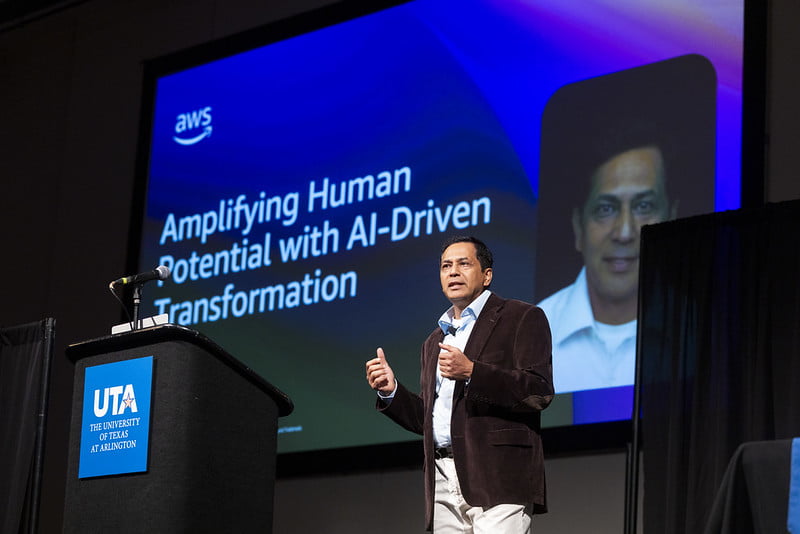
Heddese speaks to attendees from a podium. Behind him, his powerpoint features his headshot and the words "Amplifying Human Potential with AI-Driven Transformation"

UTA symposium highlights the human side of artificial intelligence

As artificial intelligence continues reshaping industries, business leaders say the organizations that succeed will be those that keep people at the center of the technology. The UTA College of Business’ 10th Annual AI and Analytics symposium brought together industry executives, faculty and students to explore the theme of “Humans in the Age of AI.” Keynote speaker Satheesh Heddese, vice president of frontline support at Amazon Web Services, described AI as part of a technological shift comparable to past disruptions such as the rise of the internet. Rather than simply optimizing existing systems, he said organizations should rethink processes entirely.